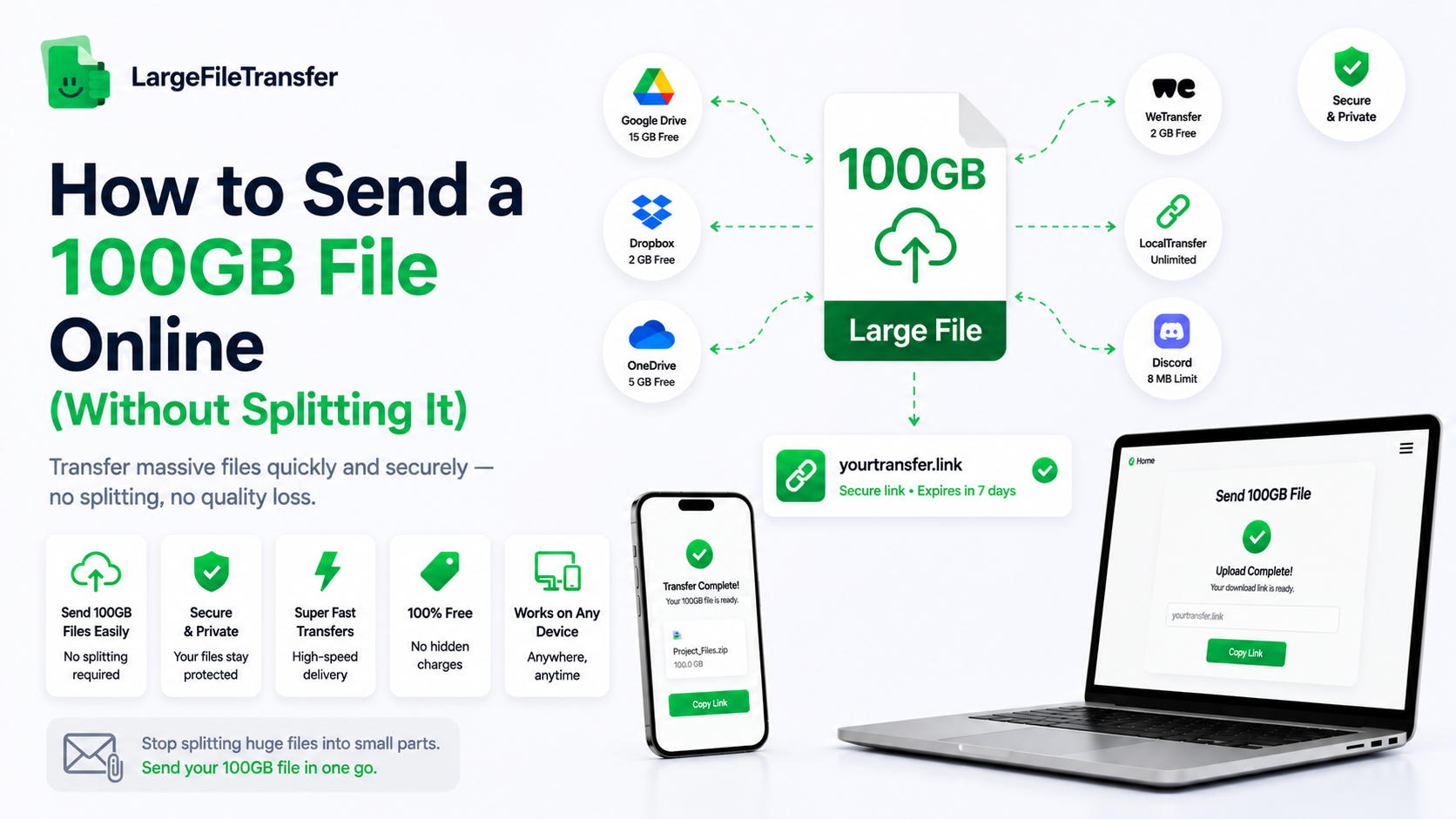
How to Send a 100GB File Online (Without Splitting It)
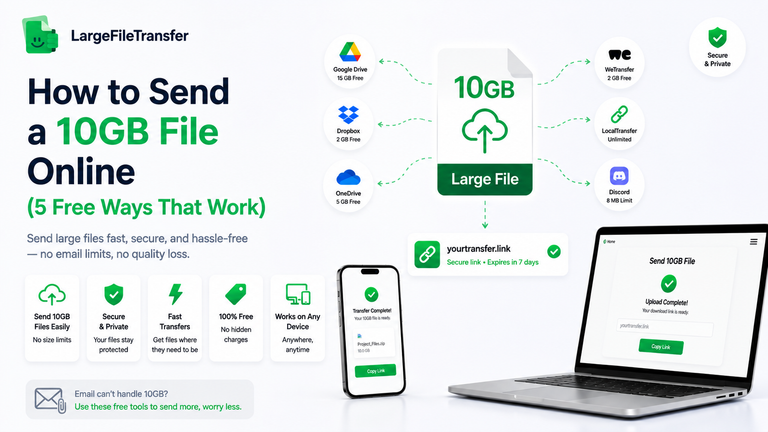
Sending a 100GB file online is beyond what almost every free tool and most paid tools support in one file.The real fix is a service built for uncapped, resumable uploads, rather than splitting the file into smaller pieces.At 100GB, you are moving production data, where transfer limits and failed uploads can quickly derail a deadline.
That could mean hours of 4K ProRes footage or an entire multi-camera event shot captured across several recording angles. For editors, studios, and data managers, the priority is moving that data intact without compression, unnecessary steps, or wasted bandwidth. A transfer that fails after several hours should not force you back to the beginning and cost another afternoon.
The right approach keeps the original file together while making large uploads recoverable when network conditions change unexpectedly.
Here’s how to send it whole, and what to expect from the transfer when deadlines matter.
Why Sending a 100GB File Is Harder Than Sending 10GB?
At 100GB, transfer costs and connection stability matter more than whether a service technically accepts the file.
A service may support 100GB files but still become expensive or unreliable when you use it regularly.
Here’s what changes at this scale:
- Many cloud plans allow 100GB files but charge extra for storage or data transfers.
These additional costs can grow quickly when you send several large projects. - Free services rarely support 100GB files, so you usually need to compare paid options.
Look at file limits, pricing, upload reliability, and recovery features before choosing a service. - Uploading 100GB can take several hours, giving unstable connections more time to interrupt the transfer.
Resumable uploads are essential because they let you continue instead of starting over. - Compression may work for smaller files, but 100GB files often contain master videos or RAW footage.
Changing these files can reduce quality or remove important metadata needed for production work.
LargeFileTransfer’s Pro plan uses flat pricing, with no file-size cap and no re-encoding during transfers. This avoids rising per-gigabyte costs while keeping the original file unchanged from upload through delivery.
Next, let’s look at how to transfer a 100GB file reliably without splitting it or restarting unnecessarily.
How to Send a 100GB File Online (Step-by-Step)
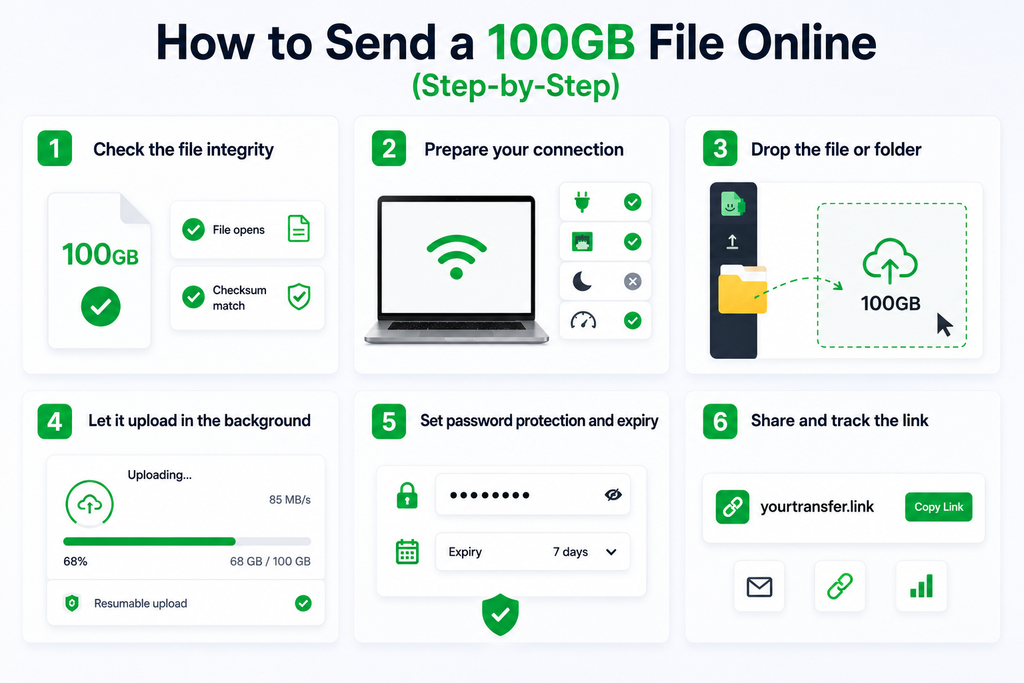
A 100GB file or an entire project folder can be sent as one transfer without splitting, archiving, or re-encoding the source material.
Before uploading, verify the source, check its integrity, and prepare your computer and connection for a long transfer.
Here’s the process:
- Check the file integrity
Confirm the final file opens correctly and matches the expected size before starting the transfer.
For critical deliveries, compare its checksum with the original export to catch corruption before spending hours uploading it.
- Prepare your connection
Connect your computer to power, disable automatic sleep, and use Ethernet where possible for better upload stability.
Close bandwidth-heavy applications and avoid starting large downloads while the 100GB upload is running.
- Drop the file or folder
Drag the complete 100GB file or project folder directly into the transfer window.
A Pro-tier plan removes the per-file size cap, so folders do not need to be zipped or split beforehand.
- Let it upload in the background
A 100GB upload can run for several hours, depending on your actual upload speed and network conditions.
Chunked, resumable uploads continue after dropped connections or a closed laptop lid instead of restarting from zero.
- Set password protection and expiry
Add a password when the transfer contains client footage, production assets, or other sensitive material.
Choose an expiry period that gives the recipient enough time to download everything without leaving the link active unnecessarily.
- Share and track the link
Send the tracked download link after the upload completes, then monitor its activity from your dashboard.
Download tracking helps confirm that a client or collaborator actually received the large transfer successfully.
At 100GB, preparation matters because a failed transfer can consume hours before the file reaches its destination.
Next, we’ll break down realistic upload times across common connection speeds, so you can plan the transfer around your deadline.
How Long Does a 100GB Upload Actually Take?
Upload time for a 100GB file depends directly on upload speed, with slower connections becoming serious bottlenecks rather than minor inconveniences.
Here’s the realistic math, at common upload speeds:
100GB = approximately 800,000 megabits
Estimated upload time = 800,000 ÷ upload speed in Mbps
| Upload speed | Approximate time | Transfer window |
| 10 Mbps | 22 hours | Overnight |
| 25 Mbps | 9 hours | Most of a workday |
| 50 Mbps | 4.4 hours | Several hours |
| 100 Mbps | 2.2 hours | Same-day |
| 300+ Mbps | 45 minutes | Under an hour |
Estimates assume an ideal, uncongested connection maintaining the stated upload speed continuously.
What affects the real-world time?
| Factor | Effect on a 100GB upload |
| Wi-Fi interference | Can reduce sustained upload speed |
| Network congestion | Slows transfers during busy periods |
| Background traffic | Shares bandwidth with the upload |
| ISP fluctuations | Can make transfer times unpredictable |
| Connection drops | Can interrupt long-running uploads |
Why upload speed matters
| Connection | Practical reality |
| 10–25 Mbps | Expect an overnight transfer |
| 50–100 Mbps | Manageable for same-day production work |
| 300+ Mbps | Suitable for faster, deadline-driven transfers |
For studios and production teams, this explains the growing value of symmetric fiber and business-grade upload speeds.
At 10–25 Mbps, moving 100GB can consume most or all of a working day, whereas faster upstream connections create more predictable delivery windows.
Because these transfers often run unattended for hours, resumability matters just as much as raw upload speed.
Use this contextual internal link in the upload-time section, ideally after the upload-speed table:
Check your actual upload speed with LargeFileTransfer’s Internet Speed Test before starting a 100GB transfer.
Should You Split a 100GB File, or Send It Whole?
Splitting large files into smaller archives was the standard workaround before resumable, uncapped upload services became widely available.
It still works today, but dividing a 100GB file creates extra steps, failure points, and work for everyone involved.
Here’s the tradeoff, honestly:
- Recipients must rebuild everything correctly.
They may need the same archiving software and must keep every numbered part together before extraction can begin successfully. - One damaged part can break everything.
If a single archive is missing or corrupted, the reconstructed file may fail, leaving you to identify and replace the faulty piece. - Both sides spend more time managing fragments.
Instead of uploading and downloading one file, everyone handles multiple archives, tracks their order, and waits for final reassembly. - Troubleshooting becomes harder at scale.
A failed 100GB transfer is already frustrating, but fragmented archives make it less obvious where the problem actually occurred. - You add unnecessary storage and organization overhead.
Temporary archive parts can consume substantial disk space while creating duplicate copies of data that eventually need cleanup.
For masters, RAW footage, and other files that must remain bit-for-bit identical, a single uncapped, resumable transfer is simpler and safer. That is exactly what a flat-rate Pro plan is built for: upload the original once without splitting or re-encoding.
Working with large video files? Read our guide on how to transfer large MP4 files without losing quality for practical guidance on preserving video quality during delivery.
What Are the Best Ways to Send a 100GB File Online?
At 100GB, the important differences between transfer methods are pricing, file-size limits, upload resilience, and workflow fit.
Here’s how the realistic options compare:
- LargeFileTransfer Pro
- File limit: 250GB per file
- Pricing: $8.99/month
- Upload: Chunked and resumable
- Storage: 5TB account storage
- Best for: Studios, editors, and teams sending large files regularly
LargeFileTransfer Pro supports files up to 250GB, so a 100GB file fits comfortably within its per-file limit. The plan includes unlimited transfers, 5TB of account storage, password protection, and links lasting up to one year or never expiring. Its fixed monthly pricing avoids per-gigabyte transfer charges, while resumable uploads help reduce the impact of connection interruptions.
- Dropbox Transfer
- File limit: Up to 100GB on supported plans, with higher limits depending on plan
- Pricing: Subscription-based
- Upload: Standard cloud transfer workflow
- File handling: Integrated with Dropbox storage and collaboration
- Best for: Teams already using Dropbox
Dropbox Transfer makes sense when your files and collaboration already happen inside Dropbox. Supported plans can handle transfers around the 100GB range, while higher limits depend on the specific subscription or add-ons. The main advantage is keeping large-file delivery within an existing Dropbox-based workflow.
- WeTransfer Pro/Premium
- File limit: Depends on the current subscription
- Pricing: Subscription-based
- Upload: Large-file transfer through shareable links
- File handling: Straightforward delivery workflow
- Best for: Occasional large sends
WeTransfer’s paid plans support large transfers, but the maximum file size depends on the current subscription and can change. Check the current allowance before relying on the service for a 100GB file or larger delivery. For existing subscribers, its link-based workflow provides a straightforward way to send occasional large files.
- Physical Drive Shipping
- File limit: Determined by drive capacity
- Pricing: Drive and courier costs
- Transfer time: No internet upload required
- Risk: Shipping, handling, and physical delivery
- Best for: Multi-terabyte archives
Shipping a physical SSD or hard drive removes internet upload time completely, making it practical for very large archives. You still need to account for drive costs, courier schedules, tracking, handling, and potential physical damage or loss. For multi-terabyte media libraries, shipping can become more practical than waiting hours or days for an online transfer.
| Method | File Limit | Pricing Model | Upload Resilience | Best For |
| LargeFileTransfer Pro | 250GB/file | $8.99/month | Chunked and resumable | Production teams |
| Dropbox Transfer | Up to 100GB+ | Subscription | Standard cloud workflow | Existing Dropbox users |
| WeTransfer Pro/Premium | Plan-dependent | Subscription | Standard transfer | Occasional large sends |
| Physical Drive | Drive capacity | Hardware + shipping | No internet upload | Multi-terabyte archives |
What to Do If Your 100GB Upload Fails Partway Through?
At 100GB, a failed upload is not a minor annoyance because restarting several hours of transfer can consume most of your workday.
The safest approach is removing predictable failure points before uploading, rather than discovering them after the transfer has already started.
Here’s what actually prevents that:
- Check for resumable uploads first: Chunked transfers preserve completed portions after interruptions, preventing a connection drop from forcing the entire upload to restart.
- Use Ethernet whenever possible: A wired connection generally provides greater stability than Wi-Fi during a transfer that may run for several hours.
- Avoid scheduled restarts: Check for operating-system updates, automatic reboots, and maintenance tasks before beginning an upload that could run overnight.
- Keep the device awake: Connect your laptop to power and disable automatic sleep so the transfer can continue unattended without interruption.
Check your connection, power settings, and system schedule before uploading. For a 100GB transfer, verify resumable uploads first, then confirm your connection and device can stay active.
Final Notes
Sending 100GB successfully comes down to two variables: your connection speed and whether the transfer resumes after interruptions occur. A flat-rate plan with a 250GB file limit also removes uncertainty around transfer costs when you regularly send large files.
That makes sending the complete file far more practical than splitting it into separate archives and rebuilding everything afterward. For most 100GB transfers today, whole-file delivery is simpler, cleaner, and less likely to introduce avoidable problems.
Ready to send your 100GB file without splitting it into smaller parts? Start your transfer with LargeFileTransfer on the dedicated 100GB send page.
FAQs
- Can I send a 100GB file for free?
Realistically, no. Free plans generally do not support files this large, so a paid flat-rate plan is the practical option.
- Is there a per-gigabyte charge for sending 100GB?
It depends on the service. Flat-rate Pro plans avoid the per-gigabyte costs that can increase quickly at 100GB.
- Will a 100GB file be compressed or re-encoded?
Not necessarily. Services built for professional files can transfer them without compression or re-encoding, but always confirm beforehand.
- How long does a 100GB upload take?
It depends on upload speed, ranging from roughly 45 minutes on fast fiber to around 22 hours at 10 Mbps.
Your actual time may be longer because of congestion, Wi-Fi limitations, or fluctuating connection speeds.
- Can I send a 100GB folder instead of a single file?
Yes. A Pro plan supporting files up to 250GB can handle a 100GB folder without requiring you to ZIP it first.